Apollo's Templates
HomeSportsBowlingPin Tracker
Bowling pin tracker · two versions

Bowling Score Sheet with Pins (Free Pin Tracker PDF)

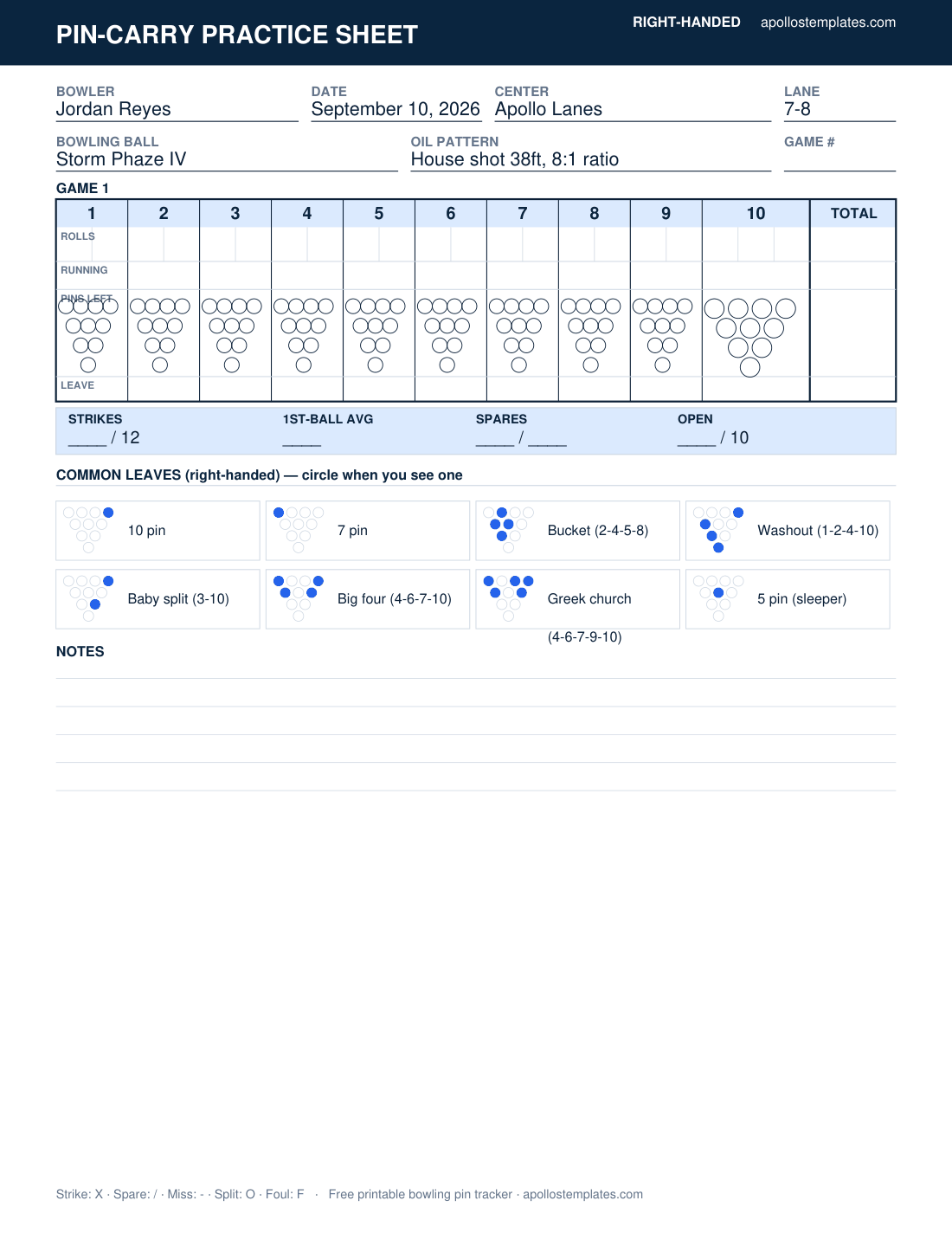
Two free pin trackers — pick the one that fits your night. The Classic Pin Tracker is a simple printable sheet with mini pin diagrams in every frame. The Pro Practice Sheet adds per-frame 10-pin diagrams, a common-leaves cheat sheet, stat fields for first-ball average and spare conversion, and right- or left-handed leave variants.

Pick a version

Two printable bowling score sheets with pins: Classic and Pro

Same goal — see what's actually happening at the pocket — handled at two levels of detail.

Version 1 · Classic

Classic Pin Tracker

The original 1-page sheet.

A standard 10-frame bowling score sheet with a mini pin diagram inside every frame. Cross out the pins that fell, mark spares — print a stack and bring them to the lanes.

  • Single page · 8 player rows
  • Standard 10-frame layout
  • Mini pin diagram inside every frame
  • Fillable PDF — type once, print many
Version 2 · Pro

Pro Practice Sheet

Per-frame pin diagrams + stats + leave cheat sheet.

Built for serious bowlers, coaches, and league analysis. Every frame gets a mini 10-pin diagram you can mark up and a leave-name field. Bottom of the page packs in a stats summary, a handedness-aware common-leaves cheat sheet, and notes lines.

  • Mini 10-pin diagram in every frame
  • Stats: strikes, 1st-ball avg, spare conversion, opens
  • Common-leaves cheat sheet (bucket / washout / Greek church / etc.)
  • Right-handed or left-handed leave variants
  • Ball + oil-pattern + lane + center fields
  • 1, 2, or 3 games per page
Version 2 builder

Pro Practice Sheet builder: pin diagrams, stats, leave chart

Updates as you type. The downloaded PDF prints to standard US Letter (8.5×11) — fits in any league bag's pocket folder.

1. Handedness

Drives the common-leaves cheat sheet at the bottom of the page. Right-handers see the 10-pin / bucket / Greek church variants; left-handers see the mirror set.

2. Games per page

1 = max detail per game (best for practice sessions). 3 = full league night on a single sheet (more compact pin diagrams).

3. Header (optional)
Bowler name
Date
Lane(s)
Center / venue
4. Conditions (optional)
Bowling ball
Oil pattern

Standard 10-frame US layout, plus a per-frame mini 10-pin diagram and a leave-name field. Bottom of the page has a stats summary row, a common-leaves cheat sheet (with mini diagrams), and notes lines. Print on US Letter (8.5×11). Built in your browser.

What you print

What the pin trackers look like

The Classic sheet is a fixed PDF; the Pro Practice Sheet is generated above with your bowler, lane, ball and oil-pattern details.
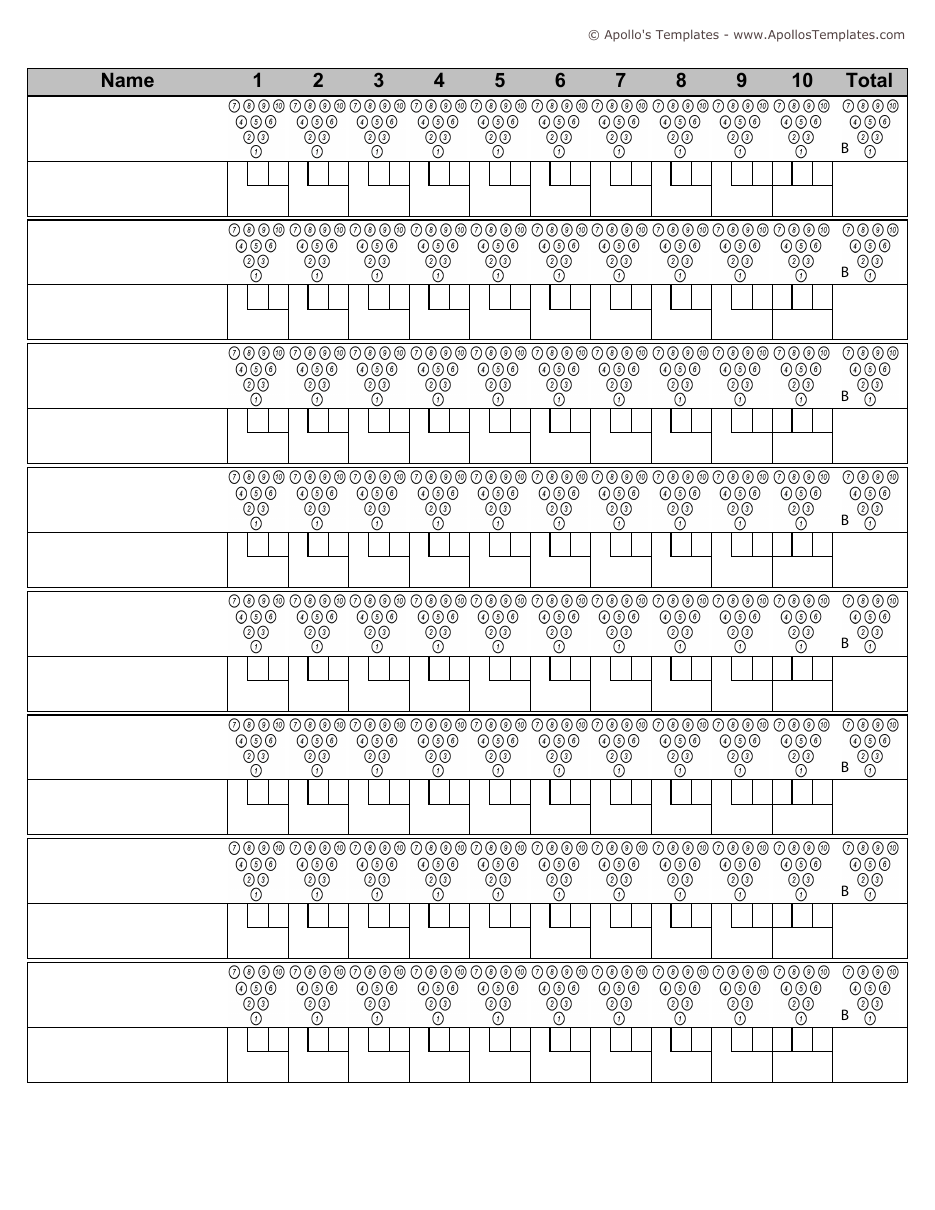
Classic bowling score sheet with a small ten-pin triangle diagram inside every frame and eight player rows on one page, fillable PDF

Classic pin tracker score sheet

Version 1. One page, eight bowlers, a pin triangle in every frame.
Pro Practice Sheet for a right-handed bowler with a 10-pin diagram inside each of ten frames, header fields for bowler, date, center, lane, ball and oil pattern, a stats row and a common-leaves chart with mini pin diagrams

Pro Practice Sheet (right-handed, 1 game)

Version 2, built above with sample header fields. 1, 2 or 3 games per page.
Quick reference

The 7 most common bowling leaves

Ranked roughly by how often a typical league bowler runs into them. The Pro Practice Sheet shows each one with its own mini diagram next to the name.

10 pin (right) · 7 pin (left)

The single corner pin. The bowler's most-faced spare — converted ~85% by good league bowlers.

Bucket

2-4-5-8 (right) or 3-5-6-9 (left). Four pins clustered like a bucket — convert with a flat hit just outside the head pin's spot.

Washout

1-2-4-10 (right) or 1-3-6-7 (left). Head pin still up — your ball came in light or hit the brooklyn side.

Baby split

3-10 (right) or 2-7 (left). Two pins separated by one missing — converted by hitting the closer pin's outside edge.

Big four

4-6-7-10 — the four corner pins. The split that defines pin carry; almost no one converts it without a deflection miracle.

Greek church

4-6-7-9-10 (right) or 4-6-7-8-10 (left). Five pins in a wide split. Famously near-impossible — only converted twice on PBA TV.

5 pin (sleeper)

The single 5-pin standing alone after a strike-looking hit. Usually means your ball hit too high on the head pin.
Asked at the lanes

Frequently asked questions

What is pin carry in bowling?
Pin carry is how cleanly your ball knocks down the pins after impact. Strong carry means light hits still drop the corner pins; weak carry leaves 10-pins, 7-pins, and washouts even when your line looked good. Tracking which pins you leave on each frame — over a series of games — is the fastest way to see whether your ball reaction is the problem or your line is.
What's a 'leave' and how do I name them?
A leave is the set of pins still standing after your first ball. Bowlers name common patterns by their pin numbers: 10 (single back-right pin), 7 (single back-left), bucket (2-4-5-8 for righties, 3-5-6-9 for lefties), washout (1-2-4-10 right / 1-3-6-7 left), baby split (3-10 or 2-7), big four (4-6-7-10), and Greek church (4-6-7-9-10). The Pro Practice Sheet's bottom panel shows each one with a mini diagram so you can identify them at a glance.
What's a good first-ball average?
First-ball average is the average pins-down on your first roll across all frames. A 9.0 means you're consistently in the pocket. League scratch bowlers typically run 8.5–9.3; PBA-level bowlers run 9.4+. Tracking it over a series tells you whether your scoring problem is carry (high first-ball avg, low strike %) or accuracy (low first-ball avg).
How do I use the per-frame pin diagrams?
After your first ball, cross out the pins that fell. Whatever's left is your leave — circle or label it (e.g., '10', 'bucket', 'washout'). After your second ball, mark whether you converted the spare. Over a few games, patterns emerge fast: if you keep leaving the 10-pin, your ball is hitting too high; if you keep leaving the 7, you're hitting flat or too low. The diagrams are the data — the fix follows.
Why does handedness matter?
Right-handers and left-handers leave mirror-image pin patterns because the ball enters the pocket from opposite sides. The common-leaves cheat sheet at the bottom of the Pro Practice Sheet shows the right-handed set by default; toggle to left-handed in the generator and the bucket, washout, and Greek church definitions flip to the lefty mirror.
Past the pin diagrams

More free bowling printables for practice and league

Score sheets
Bowling score sheets
If you want to track scores AND pin carry, print a score sheet alongside the practice sheet.
Open
Brackets
Tournament brackets
Pin tracking is for practice and self-review; the bracket generator handles tournament structure.
Open
Calculator
Handicap calculator
Pin carry shows raw potential; handicap is what your league actually scores from your average.
Open
Calculator
Score calculator
Use the score calculator to verify a game total when a roll is in dispute.
Open
Awards
Bowling award certificates
If your practice pays off and you cross 200, the 200 Club certificate is in the certificates generator.
Open
Coaching
Lane & pin diagram
Blank lane with the 10-pin layout — for marking leave patterns or planning drills.
Open
Updated September 2026 by David Nelsen — added the Pro Practice Sheet after a coaching conversation in early 2026.